
Table of Contents
ToggleTry These 5 Amazing Free AI Tools
Artificial Intelligence (AI) has transitioned from a mere buzzword to an essential tool utilized daily by millions across the globe. Regardless of whether you are a student, content creator, marketer, or entrepreneur, AI tools have the potential to save time, enhance productivity, and even ignite creativity. The most advantageous aspect? A significant number of the most effective AI tools available today are entirely free to use — at least for fundamental tasks.
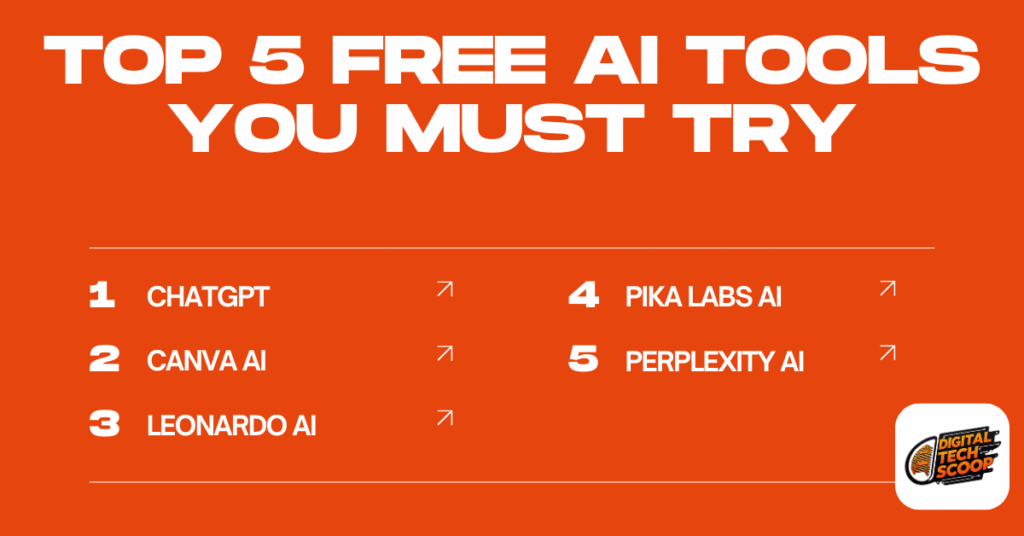
In this article, we will examine the Top 5 Free AI Tools to Experiment with in 2025 that are transforming the ways we work, learn, and create. These tools encompass a variety of applications, including text and image generators, video creators, and coding assistants. Let’s delve into the details.
01. ChatGPT by OpenAI (Free Plan)
Best for: Writing, brainstorming, coding, learning, customer support
ChatGPT, created by OpenAI, continues to be the most widely used and adaptable AI tool in 2025. Utilizing its GPT-4.5 model (accessible to pro users) and GPT-3.5 (available for free users), ChatGPT assists with a variety of tasks, including composing blog posts, generating code, solving mathematical problems, and clarifying intricate subjects in an easily understandable manner.
Key Features:
AI-powered chat interface
Writing help and grammar checks
Idea generation and brainstorming
Code writing and debugging
Summarizing articles, research, and more
Pro Tip:
Use Custom GPTs or pre-built templates to automate tasks like email writing or social media post creation. Even the free version is powerful enough for most users.
✅ Why It’s a Top Pick:
Easy to use for beginners
Free plan includes most essential features
Ideal for content creators, students, developers
02. Canva AI (Magic Studio)
Best for: Graphic design, presentations, social media content, AI image generation
Canva, which has long been a preferred choice for graphic design, will incorporate AI into its Magic Studio tools in 2025. This integration features Magic Write, AI-driven image generation, automated presentation design, and even capabilities for AI video editing — many of which are available for free
Key Features:
Magic Write: AI content writing in Canva Docs
AI Image Generator: Create unique visuals from text
Magic Design: One-click template suggestions
Text to Video (Beta)
Background remover (limited on free tier)
Pro Tip:
Even if you don’t upgrade to Canva Pro, the free version offers up to 5 uses/day of Magic Write, and limited AI image generation — enough for casual creators or bloggers.
✅ Why It’s a Top Pick:
No design skills needed
All-in-one tool for content creators
Beginner-friendly with drag-and-drop interface

03. Leonardo AI (Free Tier)
Best for: AI art, game assets, illustrations, and high-quality images
If you have an interest in AI-generated images and digital art, Leonardo AI is emerging as a prominent figure in 2025. In contrast to other image generators, Leonardo focuses on producing ultra-detailed, stylized images that are ideal for game developers, NFT creators, and artists.
Key Features:
High-quality image generation from text
Pre-built styles and templates (anime, cyberpunk, realism)
Canvas editor for adjusting details
Prompt refinement for consistent art direction
150 free tokens per day (1 image = ~3–10 tokens)
Pro Tip:
Use Leonardo’s “Prompt Magic” and “Canvas Editor” for professional-level results, even on the free plan. Great for creating YouTube thumbnails, game scenes, or unique art.
✅ Why It’s a Top Pick:
Better detail and control than MidJourney (for free users)
Free tier with generous daily credits
Great for artists and content marketers
04. Pika Labs AI (Video Generator)
Best for: AI video creation, animation, storyboards
Pika Labs stands out as one of the most thrilling AI video tools in 2025.
With just a text prompt, users can create animated videos, cinematic scenes, product animations, or imaginative visual narratives.
Also the free version offers a robust experience.
Key Features:
Generate short AI videos from text
Add motion to still images
Customize camera movement, lighting, and art style
Supports cinematic and anime-style rendering
Pro Tip:
Use Pika for marketing videos, TikToks, or YouTube Shorts. Combine it with AI voiceovers or text from ChatGPT for a full video workflow.
✅ Why It’s a Top Pick:
Unique among free tools — video generation is hard to find for free
Easy to use with great quality output
Great for content creators and educators
05. Perplexity AI (Free with Pro Option)
Best for: AI-powered research, summaries, citations, fact-checking
For swift and precise research, Perplexity AI is the optimal choice. Consider it a more intelligent iteration of Google Search — enhanced by an AI assistant. It not only locates answers but also references sources, offers related inquiries, and facilitates in-depth exploration of subjects.
Key Features:
Natural language search interface
Source citations for every result
AI-powered summaries
“Copilot” mode (GPT-4 for pro users)
Pro Tip:
Use Perplexity to generate outlines, citations, and content briefs—especially helpful for bloggers and students. It’s one of the few AI tools that directly links to sources, so it’s also great for fact-checking.
✅ Why It’s a Top Pick:
Reliable results with references
Replaces hours of manual Googling
No sign-up required
Bonus Tools to Explore in 2025
GrammarlyGO – AI writing assistant integrated with email, docs, etc.
Runway ML (Free Tools) – Text to video and green screen removal
Adobe Firefly (Free Plan) – AI image tools and effects from Adobe
Notion AI – Writing, summarizing, and auto-organization for students/professionals
Hugging Face Spaces – Free community-powered AI tools for developers
Final Thoughts
The rise of free AI tools in 2025 has leveled the playing field for creators, professionals, and students. Whether you want to create art, write better, build content faster, or generate videos — these tools are more accessible than ever.
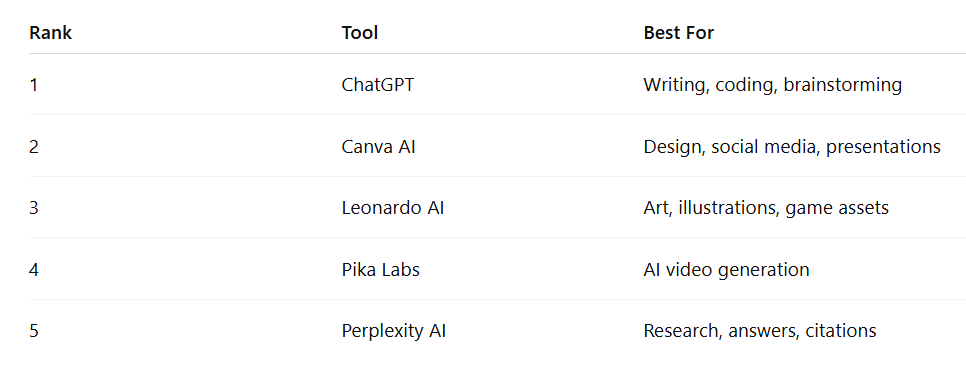
Here’s a quick recap of the Top 5 Free AI Tools:
Tips to Get the Most Out of Top 5 Free AI Tools:
Combine tools: Use ChatGPT for scripting, Canva for design, and Pika for video.
Sign up for free plans: Many tools offer better functionality when you create a free account.
Stay updated: AI tools are continually improving — check for new features regularly.
Avoid overuse: Free plans have limits, so be strategic with usage.
Ready to Explore the Future?
In 2025, the capabilities of artificial intelligence are accessible to everyone — and the most advantageous aspect is that you can begin without any financial investment. These Top 5 Free AI Tools are revolutionizing the landscape for creators, students, marketers, and developers alike. Ranging from writing and design to video production and research, each of the Top 5 Free AI Tools we discussed provides genuine value without any initial cost.
If you are prepared to enhance your efficiency and accelerate your creative process, begin exploring these Top 5 Free AI Tools today. Regardless of whether you are a novice or an expert, these tools demonstrate that innovation does not necessarily require a financial outlay.
Be sure to save this guide and share it with your friends — the future is upon us, and it commences with the Top 5 Free AI Tools!
Appreciate this content? Bookmark DigitalTechScoop.com for additional expert technology reviews, insights on AI, and tips for enhancing productivity!
FAQs
As an AI-driven affiliate marketer, you have the opportunity to earn income by endorsing products or services from other companies and receiving a commission. AI tools can assist you in establishing an affiliate marketing website by analyzing search trends to determine which products are valuable to showcase.
Indeed, Siri represents a category of Artificial Intelligence, more specifically a kind of AI known as a virtual assistant.
Real-world AI risks. There exists a multitude of risks associated with AI that we encounter in our daily lives. Not all AI risks are as significant and alarming as autonomous weapons or sentient artificial intelligence. Some of the most pressing risks today encompass issues such as consumer privacy, biased algorithms, threats to human safety, and ambiguous legal regulations.