

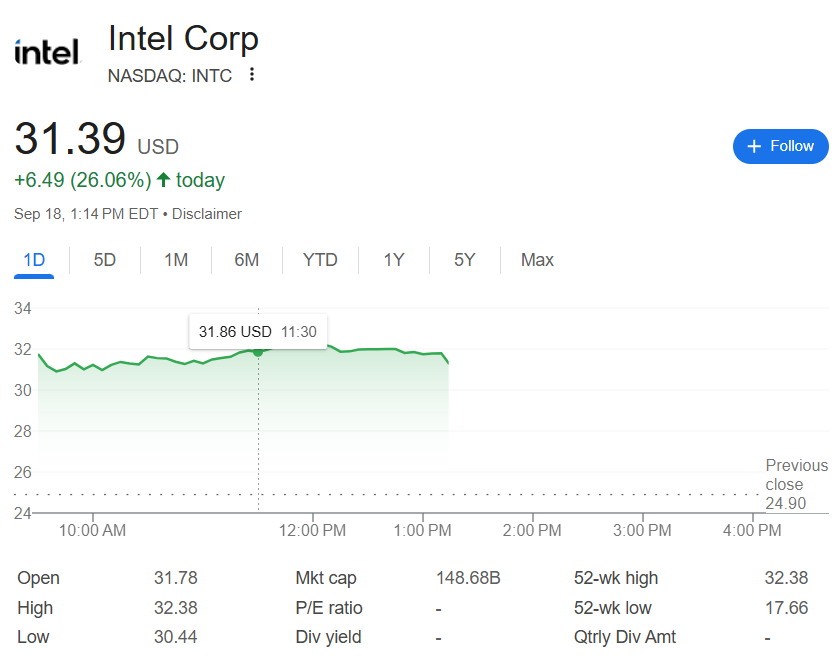
Intel stock has been on a rollercoaster ride in recent years, weighed down by missed deadlines, stiff competition, and investor frustration. But September 2025 has delivered a dramatic turnaround. In a surprising move, NVIDIA announced it will invest $5 billion in Intel and collaborate on developing new chips for data centers and personal computing. This news, combined with strong government and corporate support, has sent Intel stock soaring more than 30% in a single session.
So, what’s behind this historic partnership, and what does it mean for investors? Let’s break it down.
Table of Contents
Toggle1. NVIDIA and Intel Announce Historic Collaboration
On Thursday, NVIDIA (NASDAQ: NVDA) and Intel Corporation (NASDAQ: INTC) revealed a multi-year collaboration that will reshape the future of AI infrastructure and personal computing. The companies will jointly develop several generations of custom chips that connect NVIDIA’s GPU and AI platforms with Intel’s x86 CPU ecosystem.
The agreement centers on NVIDIA NVLink, a high-bandwidth interconnect technology. By using NVLink, Intel and NVIDIA aim to integrate their respective strengths into unified platforms that can accelerate workloads across hyperscale data centers, enterprises, and even consumer devices.
2. $5 Billion Vote of Confidence
As part of the deal, NVIDIA will purchase $5 billion worth of Intel common stock at $23.28 per share. This investment is more than symbolic. It signals NVIDIA’s confidence in Intel’s ability to regain its footing in a fiercely competitive semiconductor market.
Following the announcement, Intel stock surged more than 32%, climbing from historic lows earlier this year. The rally highlights renewed optimism among investors who had grown skeptical of Intel’s turnaround prospects.
3. Data Center Impact: NVIDIA-Custom CPUs
The collaboration’s primary focus is on the data center industry, where there is a rapidly growing need for AI infrastructure. NVIDIA will include the x86 CPUs that Intel designs and produces into its AI infrastructure platforms.
This implies that Intel is now creating custom CPUs for NVIDIA’s state-of-the-art AI systems rather than only providing generic chips. This collaboration gives Intel a much-needed boost in a market where rivals based on AMD and ARM have been gaining ground.

4. Consumer Breakthrough: x86 RTX SoCs
Beyond the data center, Intel and NVIDIA plan to reshape personal computing. Intel will produce x86 system-on-chips (SoCs) that integrate NVIDIA RTX GPU chiplets. These chips will power next-generation PCs, blending Intel’s CPU expertise with NVIDIA’s graphics and AI acceleration.
For consumers, this could mean laptops and desktops that seamlessly handle demanding AI workloads, gaming, and productivity tasks—all in a more power-efficient package. For Intel stockholders, it signals a new growth avenue in the PC market.
5. Government and Corporate Backing
Intel’s comeback is not occurring in a vacuum. Earlier this year, the U.S. government took a 10% equity stake in Intel as part of a larger initiative to bolster domestic semiconductor production. Shortly thereafter, SoftBank invested billions into the firm. Now, with NVIDIA becoming another prominent investor, Intel has gained three influential supporters.
Kush Desai, the deputy press secretary at the White House, praised the collaboration between NVIDIA and Intel as a “significant achievement for American high-tech manufacturing,” highlighting its importance for U.S. competitiveness in the international chip industry.
6. Investor Sentiment Turns Positive
Shareholders’ patience has been put to the test for years by Intel stock. The business lost ground to rivals in both CPUs and GPUs as a result of delayed manufacturing changes. However, things appear to be changing.
After the NVIDIA statement, one analyst said, “After years of pain and frustration for investors, these have been a golden few weeks for Intel.”
Many investors are now looking again at Intel as a possible comeback story in the AI era, as the company’s price has recovered from ten-year lows.
7. What’s Next for Intel Stock?
While excitement is high, there are still risks. The deal is subject to regulatory approvals, including antitrust clearance, and the success of the collaboration depends on timely product execution. Forward-looking statements from both NVIDIA and Intel acknowledge uncertainties in market adoption, supply chain challenges, and competitive pressures.
Still, if the companies deliver on their promises, Intel stock could benefit from:
Expanded role in AI infrastructure.
New PC market opportunities through RTX-integrated SoCs.
Increased investor and government confidence.
A stronger ecosystem partnership with NVIDIA, one of the most valuable companies in tech.
Final Thoughts
Intel’s stock is experiencing a significant resurgence, attributed to NVIDIA’s $5 billion investment and a bold partnership aimed at creating next-generation chips. With support from the government, backing from corporations, and a revitalized strategic focus, Intel has established itself as a pivotal entity in the AI-driven future of computing.
For investors, the upcoming months will be critical in assessing whether this collaboration leads to enduring growth. It is evident that after a series of challenges, Intel’s stock has once again captured attention.
FAQs
NVIDIA invested $5 billion in Intel to strengthen a long-term partnership aimed at building custom AI and PC chips. It’s a strategic move that benefits both companies.
No. Intel will not manufacture NVIDIA GPUs directly. Instead, it will design and build CPUs and SoCs that integrate with NVIDIA GPU technology.
That depends on investor risk tolerance. While the NVIDIA partnership is a strong positive, execution risks and market competition remain.